
When diplomacy meets data, you usually get policy papers or working groups. This summer, we got something different: a 48-hour hackathon that challenged thirty students to reimagine what an embassy could be. The brief was clear and ambitious: what if the next embassy isn't built with bricks, but with code?
Although the hackathon officially spanned 48 hours, parallel workshops, briefings, and pitch preparation meant we had only about 18 hours of real development time, which forced rapid prototyping and decisive architectural choices.
Our interdisciplinary team, comprised of Sebastian Ruffert, Raphael Hauser, Shu-Xiang Yang, and myself, built EuroMesh: a mesh-networked digital embassy concept designed to keep citizens safe when traditional infrastructure fails. The result earned us second place and demonstrated that resilient crisis communication systems are not just theoretically possible, but architecturally feasible with current technology.
The Problem Space
Traditional embassies work well until they're needed most. During crises such as natural disasters, civil unrest, or infrastructure failures, embassies can become inaccessible or overwhelmed precisely when citizens require support. The challenges are interconnected and amplify each other:
- Information fragmentation: Critical updates become stale within minutes. Safe routes close, danger zones shift, but there's no mechanism for real-time updates to reach people on the ground.
- Communication breakdown: When cellular networks fail, traditional apps become useless. Your emergency contacts, location services, and information sources disappear simultaneously.
- Trust and verification: In chaos, misinformation spreads exponentially. Without trusted sources or verification mechanisms, rumors become indistinguishable from facts.
The worst-case scenario: you're abroad, infrastructure is down, your phone has battery but no connectivity, and you have no reliable way to get help or information. This is the problem we set out to solve, a challenge directly aimed at the core mission of any diplomatic presence: citizen security.
Technical Architecture: Designing for Resilience
As the technical lead, I designed EuroMesh to transform smartphones into resilient communication nodes that relay information without traditional infrastructure. Inspired by Apple's AirDrop, the conceptual architecture uses Bluetooth Low Energy for device discovery and negotiates peer-to-peer Wi-Fi connections for data transfer. This ensures critical information can be shared even when cellular or internet services fail. Given the 48-hour constraint, we simulated this mesh networking layer with local JSON persistence to focus on demonstrating the complete user experience and data flow patterns.

Each device would function as a router in a self-healing mesh network. Messages, location updates, and emergency alerts propagate through the network via multi-hop relay protocols, ensuring information reaches its destination even when direct paths are unavailable.
Smart Activation System
The network is designed to activate only during genuine crises through authority-triggered signals broadcast via cellular, satellite, or local Bluetooth beacons. This prevents unnecessary battery drain and ensures the system scales appropriately to crisis severity. Our prototype included a manual "crisis mode" toggle to demonstrate this activation flow without requiring actual emergency broadcast infrastructure.
Dynamic Crisis Mapping System
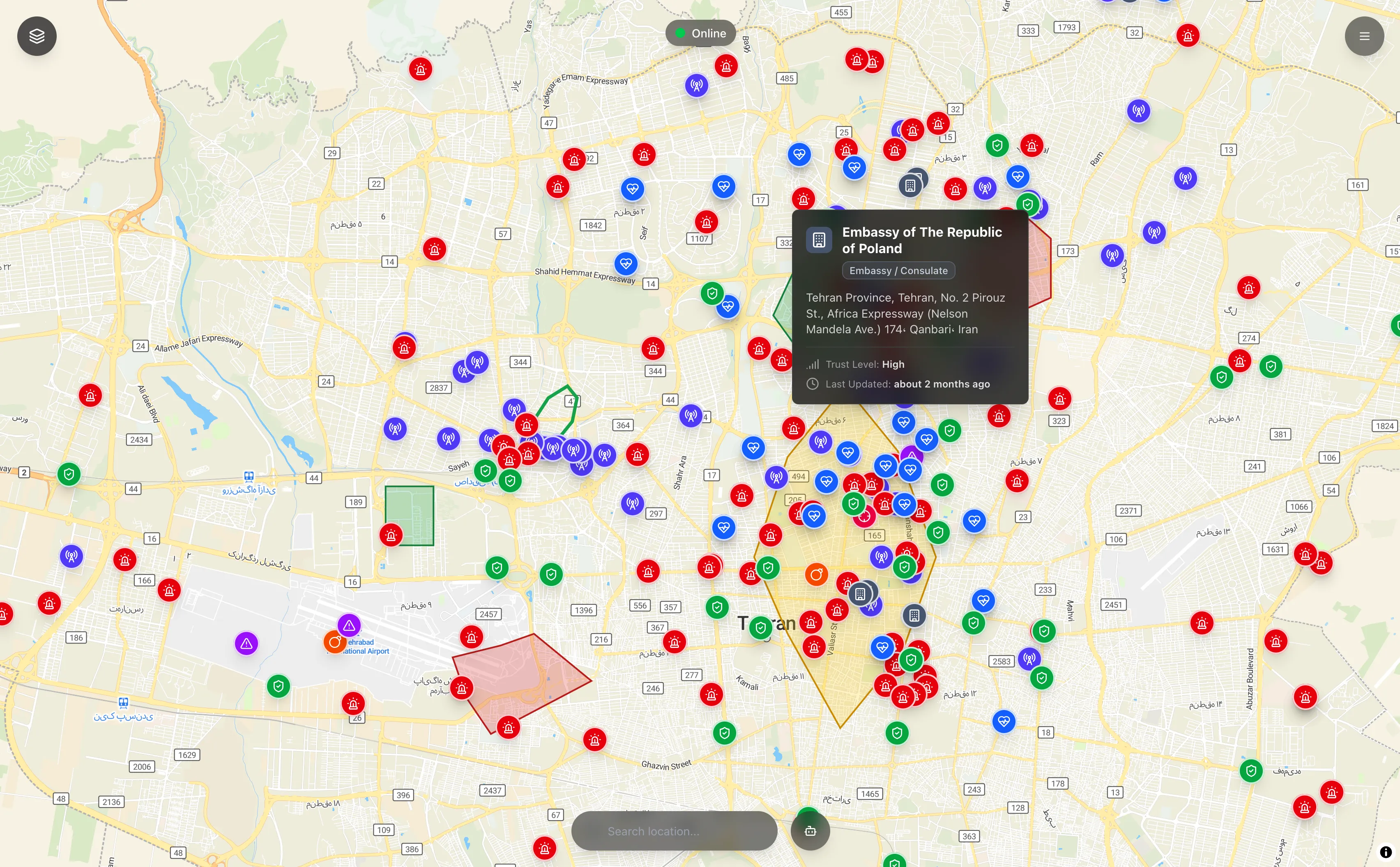
The core interface combines official embassy data with crowdsourced intelligence from mesh network participants. We designed a type-safe data structure that supports both static safety information (embassy locations, safe zones, evacuation routes) and dynamic incident reports from field participants.
When the mesh activates, the map becomes a real-time situational awareness layer. Areas are classified using a traffic-light system with comprehensive categorization for different threat types and safety resources.
1// Type-safe landmark system for crisis categorization2export type LandmarkCategory =3 | "safe_space" // Verified safe zones4 | "dangerous_spot" // Known hazards5 | "communication" // Network access points6 | "trusted_contact" // Local assistance7 | "medical" // Healthcare facilities8 | "checkpoint" // Official control points9 | "embassy" // Diplomatic facilities10 | "explosion" // Immediate threats11 | "attack" // Security incidents12 | "disaster"; // Natural disasters1314export interface Location {15 lat: number;16 lng: number;17}1819export interface Landmark {20 id: string;21 name: string;22 description?: string;23 location: Location;24 radius?: number; // Area of effect25 category: LandmarkCategory;26 trustLevel?: "high" | "medium" | "low";27 lastUpdated?: string;28 addedBy?: string; // Source attribution29 isVerified?: boolean; // Official confirmation30 visible?: boolean; // Display toggle31}The trust scoring system prevents information pollution while enabling rapid sharing. Reports start with low trust scores and gain credibility through independent confirmation from multiple network participants, implemented through the trustLevel and isVerified validation pipeline.
AI-Powered Crisis Assistant
Crisis communication must be multilingual, contextual, and accessible under extreme stress. For the prototype, we architected an AI assistant using Gemini 2.5 Flash that operates entirely on local data to ensure reliability when connectivity is intermittent. In a production environment, this would be replaced by a fully local LLM to ensure maximum privacy and offline capability. The system implements structured conversation flows optimized for high-stress scenarios.
The assistant's conversation flow is engineered for cognitive load management under stress. It guides users through incident reporting with a specific sequence: category identification, detailed description, then location collection. This ordering prevents conversational dead-ends and ensures complete data collection even when users are distracted or experiencing crisis-related cognitive impairment.
Offline Identity Verification System
Traditional identity verification requires database connectivity and complex authentication flows. We designed a simplified digital passport wallet that demonstrates offline identity verification through QR codes. This system is designed for pre-identified German or EU citizens, requiring initial setup with a passport to ensure secure and restricted access. While our prototype uses basic string encoding for demonstration purposes, the architecture supports cryptographic signatures for production deployment.
Embassy officials can verify citizen identity by scanning QR codes with any smartphone, maintaining functionality during complete network isolation. This system is envisioned to coordinate with allied countries' border controls, providing a verifiable identity even if physical travel documents are lost, facilitating safe passage during emergencies. The modular design allows easy integration of cryptographic signatures and certificate chains for production deployment.
Architectural Decisions and Constraints
The 48-hour timeframe demanded strategic technical decisions. We prioritized demonstrating the complete user experience and data flow patterns over implementing full mesh networking protocols. The JSON-based persistence layer serves as a functional prototype that clearly illustrates the data structures and API patterns required for production mesh implementation. Key architectural choices included offline-first data design where all critical functionality works without network connectivity, with mesh synchronization as an enhancement rather than a requirement. Type-safe interfaces ensure data consistency across the distributed system and provide clear contracts for future mesh protocol implementation. The modular component architecture enables each system component (mapping, AI assistant, identity verification) to operate independently, enabling parallel development and future feature expansion.
Results and Technical Validation
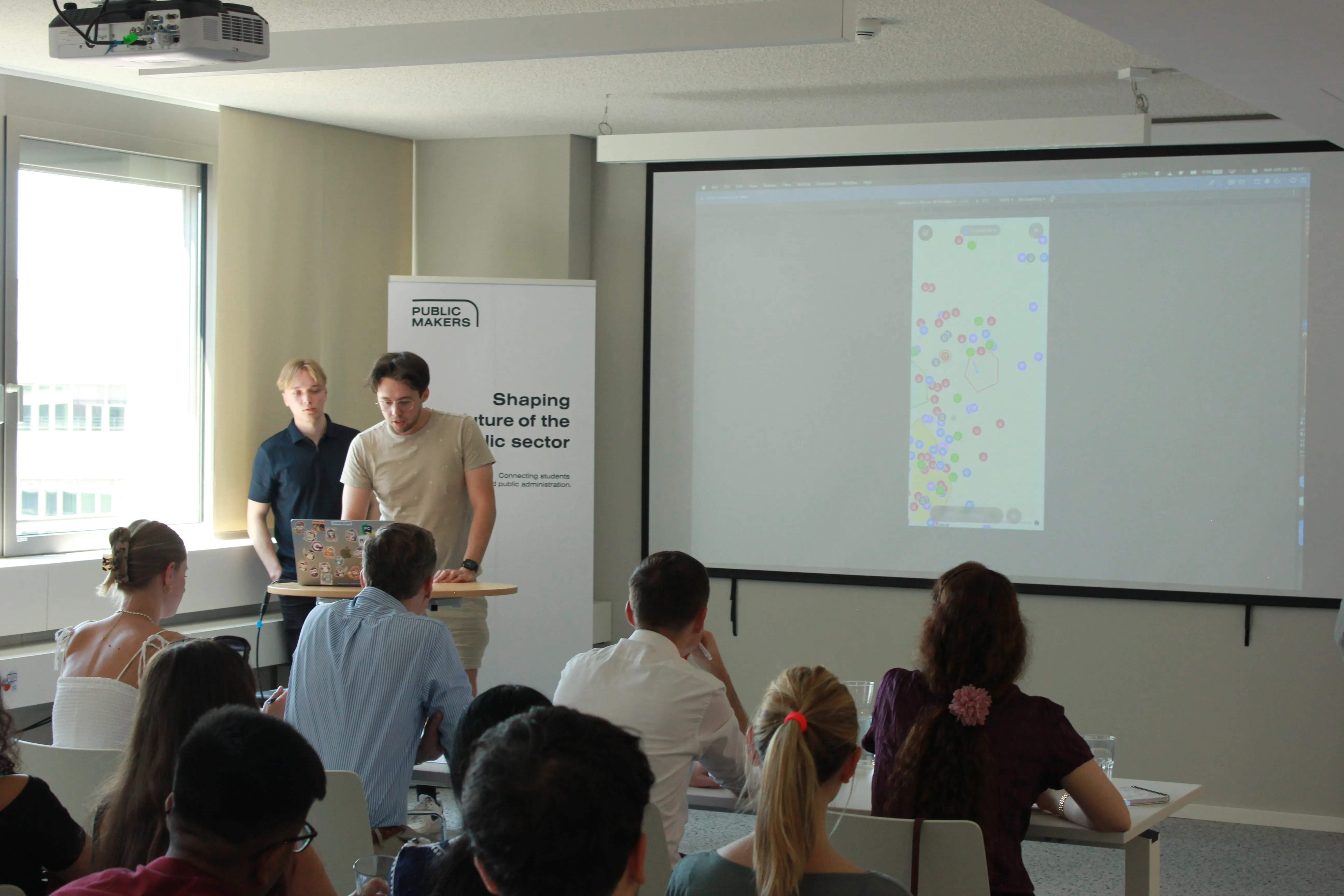
EuroMesh secured second place among eight teams, with judges specifically noting our technical architecture and practical approach to offline resilience. The project successfully demonstrated that mesh networking can provide meaningful crisis communication capabilities using consumer hardware.
Beyond the competition results, conversations with professionals in the sector during the event validated that our technical solution addresses genuine operational challenges in crisis response scenarios. The offline-first and decentralized architecture particularly resonated with technical evaluators familiar with real-world deployment constraints.
The prototype successfully demonstrated complete user workflows: crisis activation, incident reporting, map visualization, AI assistance, and identity verification, all functioning without external network dependencies.
Potential Future Development
While transitioning EuroMesh from prototype to production would be a significant engineering challenge, the modular architecture provides a solid foundation. Future work would involve replacing the simulated data layer with robust Bluetooth and Wi-Fi protocols, implementing end-to-end cryptographic security, and addressing real-world challenges like battery optimization and device compatibility. These steps, while complex, offer a path toward making this concept a reality.
Conclusion: What's Next for GovTech?
EuroMesh was born in a 48-hour hackathon, but it answers a fundamental question: how do we build government services that are truly resilient? Our prototype proves it's possible to create secure, functional communication tools that work when everything else fails. But a proof-of-concept isn't enough. The real challenge is bridging the gap from a hackathon project to a production-ready system. That requires collaboration between developers, diplomats, and policymakers to build, test, and deploy the next generation of crisis technology. The code is written, the concept is proven, now, the real work begins.